Table of contents
Contactless has become the benchmark
The UK’s contactless payments experience is one of the great success stories of modern financial services. A customer reaches for their phone or bank card, holds it against a payment terminal and, within moments, the payment is complete. The interaction is so familiar that we rarely stop to think about what sits behind it, yet it represents decades of investment, refinement and collaboration across banks, card schemes, payment providers, device manufacturers and retailers.
Pay by Bank has made remarkable progress since its inception. Millions of people now use it every month, while businesses benefit from immediate settlement, lower acceptance costs and payments that move directly from the customer’s bank account to their own. Online, those advantages are increasingly well understood, making Pay by Bank an easy commercial decision for many merchants.
The physical point of sale presents a different challenge.
The challenge isn’t the technology
It is tempting to assume that the gap is technological, but the technology required to move money instantly between bank accounts already exists. Banks have invested heavily in Open Banking infrastructure and payment providers have demonstrated that direct bank payments are fast, secure and reliable.
The greater challenge is creating an experience that can stand alongside contactless in the environments where speed and familiarity matter most.
Consumers have already told us how they want to pay in person. They expect the experience to be quick, intuitive and dependable, regardless of what happens behind the scenes. They do not choose payment rails; they choose the simplest and most familiar way to complete a purchase.
If direct bank payments are to become a genuine alternative in physical retail, they need to fit naturally within those expectations rather than asking consumers to adopt a different behaviour. Competition should not depend on consumers accepting a less convenient experience simply because a payment takes a different route.
Bringing Pay by Bank to the counter
That simple observation has shaped our thinking at Wonderful. For years we’ve helped businesses and charities accept Pay by Bank online, where customers are already completing a purchase on a screen. Bringing the same proposition into face-to-face payments required us to stop thinking about devices and start thinking about behaviour. The question was never how to build another payment terminal. It was how closely a direct bank payment could reflect the experience people already know - and by people, we mean businesses as well as their customers.
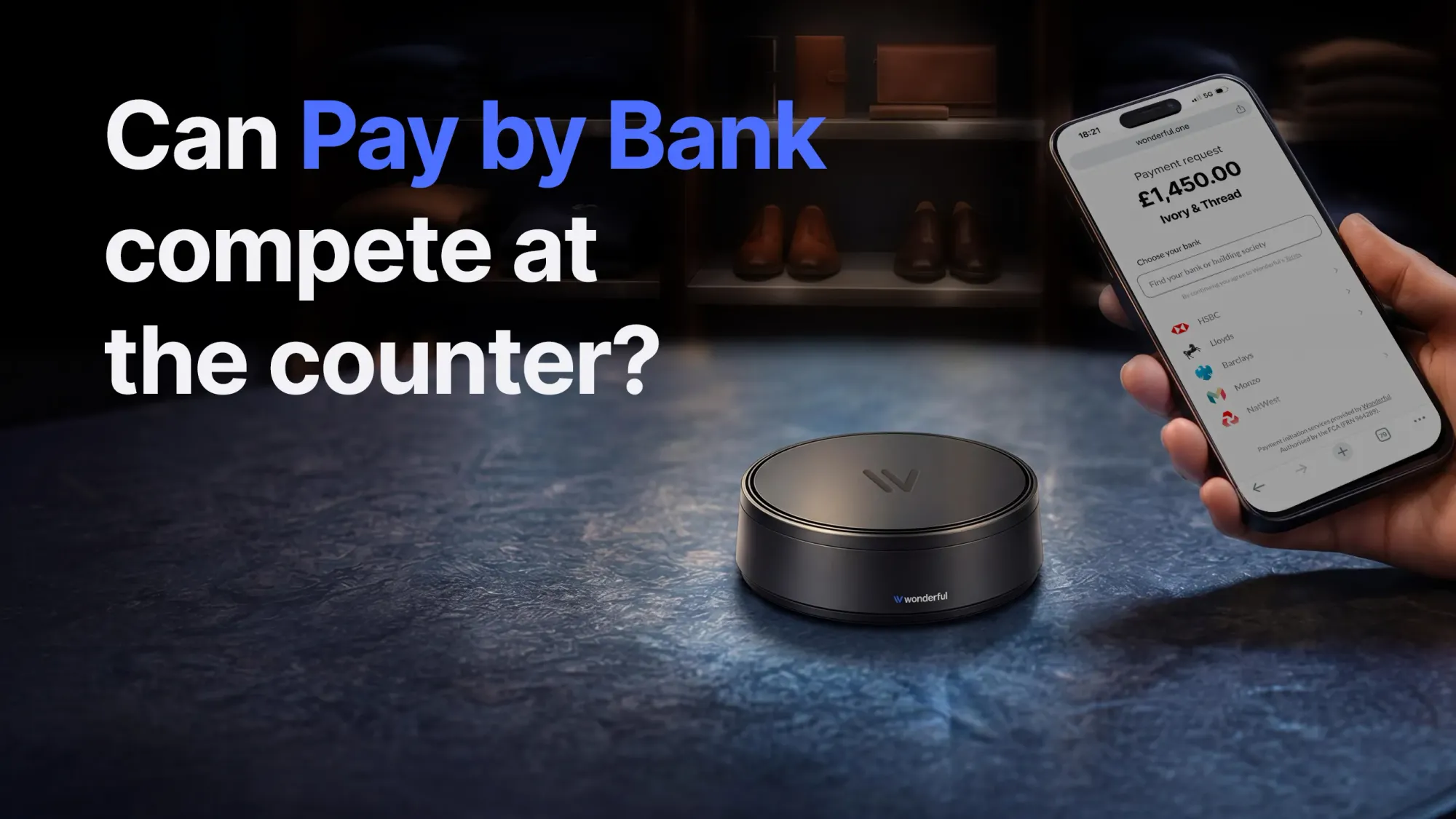
That thinking led to the Wonderful Tap beta.
The response has been really encouraging, not simply because of the number of businesses expressing an interest, but because of their diversity. Cafés, charities, driving instructors, car dealerships, clothing retailers and market traders all approach payments differently, yet they are asking remarkably similar questions.
Regardless of sector, the same themes emerge repeatedly. Businesses want to know whether Pay by Bank can become a practical choice wherever customers choose to pay, whether it can reduce payment costs without compromising the customer experience, and whether it can work just as naturally at a busy counter as it already does during an online checkout.
What we’re already learning from the beta
One of our earliest beta participants runs a successful fish and chip restaurant and has a background in financial services software development. Having built his own bespoke online ordering platform, integrating Wonderful Tap was an obvious next step. His experience reinforces something we’ve suspected for some time.
For online ordering, Pay by Bank is already an obvious choice.
Inside the restaurant, where customers often settle the bill while finishing a coffee after their meal, the current experience is entirely workable. A few extra moments to authenticate a payment simply aren’t important.
At the takeaway counter, however, every second counts. Contactless has set an exceptionally high standard, and that is where any alternative must ultimately prove itself.
That distinction matters because it reminds us that “in-person payments” are not a single use case. Different trading environments place very different demands on the payment journey, and understanding those differences is every bit as important as the technology itself.
High-velocity retail remains the hardest test
Working alongside businesses like these has already influenced the way Wonderful Tap has evolved. Merchants can continue serving customers without waiting for one payment journey to finish before helping the next, allowing queues to keep moving naturally.
Even so, we’d be deluding ourselves, and everyone else, if we claimed today’s experience already matches the immediacy of contactless in every high-velocity retail environment. It doesn’t, particularly where customers expect to pay in seconds and queues are constantly moving.
The market trader serving a lunchtime queue is facing a different challenge from the restaurant owner whose customers are relaxing over coffee. Our aim is to make Pay by Bank work naturally in both environments, but the former remains the harder test.
The important point is that we don’t believe this is because direct bank payments are fundamentally incapable of doing so. We believe the remaining barriers are commercial and structural rather than technical. The UK has spent years creating an outstanding contactless experience, and that’s exactly as it should be.
If we want genuine competition in payments, alternatives need the opportunity to compete on the quality of the customer experience, rather than asking consumers to accept something less convenient.
Competing on customer experience
The Wonderful Tap beta is helping us refine a product, but it’s also helping us answer a much bigger question.
Can direct bank payments deliver an in-person experience that’s compelling enough to give merchants meaningful choice without asking consumers to change the way they naturally want to pay?
We believe the answer is yes.
Not because consumers need a new habit, but precisely because they don’t.
Contactless became the UK’s preferred way to pay because it delivered an outstanding customer experience. If Pay by Bank is to become a genuine alternative in physical retail, the same principle applies.
Merchants deserve the freedom to choose a payment method that works for their business. Consumers deserve the same familiar, intuitive experience they’ve already told us they value. The opportunity for our industry is to ensure they never have to choose between the two.