
Why Pay by Bank instant settlement matters more than low fees for small businesses
Kieron James
-
Pay by Bank is often discussed in terms of cost, and that is part of the story. For many UK small businesses, though, the bigger advantage is much simpler: getting hold of your money straight away.
Table of contents
When small businesses compare payment methods, the first question is usually about fees, which is completely understandable. Margins are tight, card costs add up quickly, and nobody wants to hand over more of each sale than necessary.
But there is another question that often matters more in practice: how long does it take before the money is actually available to use?
That distinction is easy to miss. A payment can be authorised immediately, the customer can walk away happy, and the sale can look complete on screen, while the business itself is still waiting for funds to clear through the usual settlement process. With Pay by Bank, that gap is far smaller - and for Wonderful merchants, near instant. This is because the payment moves over UK bank payment rails in real time, with the customer approving it directly in their banking app.^1,2
For a large company with deep reserves, delayed access to funds may be an irritation. For a UK small business, it can be existential.
What instant settlement means
In this context, instant settlement means the business receives usable funds within seconds, or very shortly after the customer approves the payment, rather than waiting for a card acquirer’s payout cycle. Open Banking Limited describes Pay by Bank as a secure bank to bank payment initiated with the customer’s consent, and Pay.UK says the Faster Payment System operates day and night, 365 days a year, supporting real-time payments for businesses and consumers across the UK.^1,2
That does not mean every single transaction in every configuration will land in exactly the same number of seconds. Pay.UK notes that funds are usually available almost immediately, although in some cases they can take up to two hours.^3 Even with that caveat, the contrast with the normal card model is obvious. Card authorisation feels instant to the customer, but settlement for the merchant typically follows later, often on a one to three business day timetable depending on the provider and setup.^4,5
Why UK small businesses feel the delay more acutely
Cash flow is not an abstract finance term for most small firms. It is the practical question of whether there is enough money in the account to restock, cover wages, pay the VAT bill, settle with suppliers, or simply start the next day without unnecessary anxiety.
That is one reason late payments remain such a live political and commercial issue in the UK. The government’s 2026 response on late payments again put cash flow at the centre of the small business problem, and the policy annex to its SME plan said late payment costs the UK economy almost £11 billion a year and contributes to the closure of thousands of businesses.^6,7 Those figures relate to business-to-business invoicing rather than card settlement, but the underlying point is the same: delayed access to money creates stress, friction and weakness in smaller firms long before it becomes an accounting problem.
Seen in that light, Pay by Bank is not only about shaving basis points off acceptance cost. It is about shortening the distance between making a sale and being able to use the proceeds of that sale.
Low fees are good, immediate funds are often better
There is no need to pretend price does not matter. It does. If a business can reduce payment costs, that saving drops straight to the bottom line. But lower fees usually create value gradually. Instant settlement changes behaviour immediately.
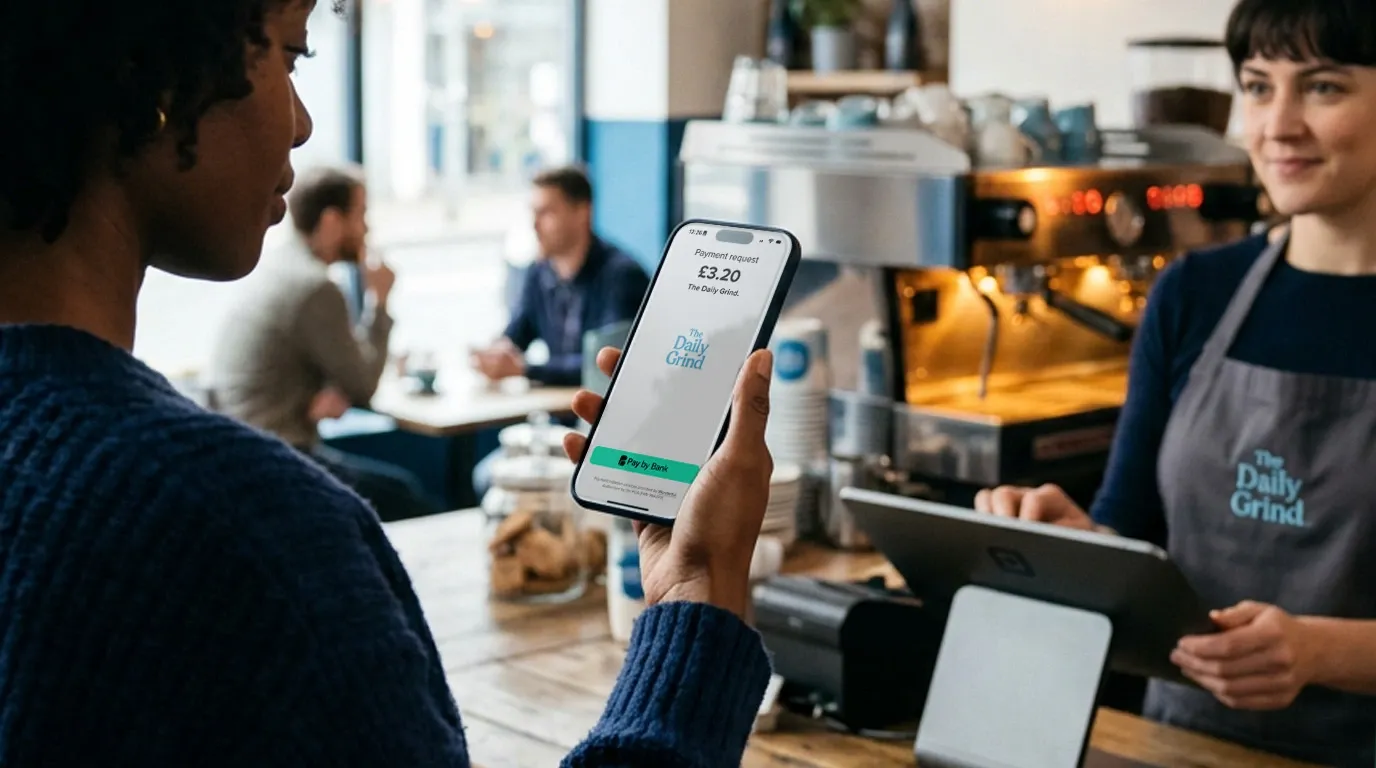
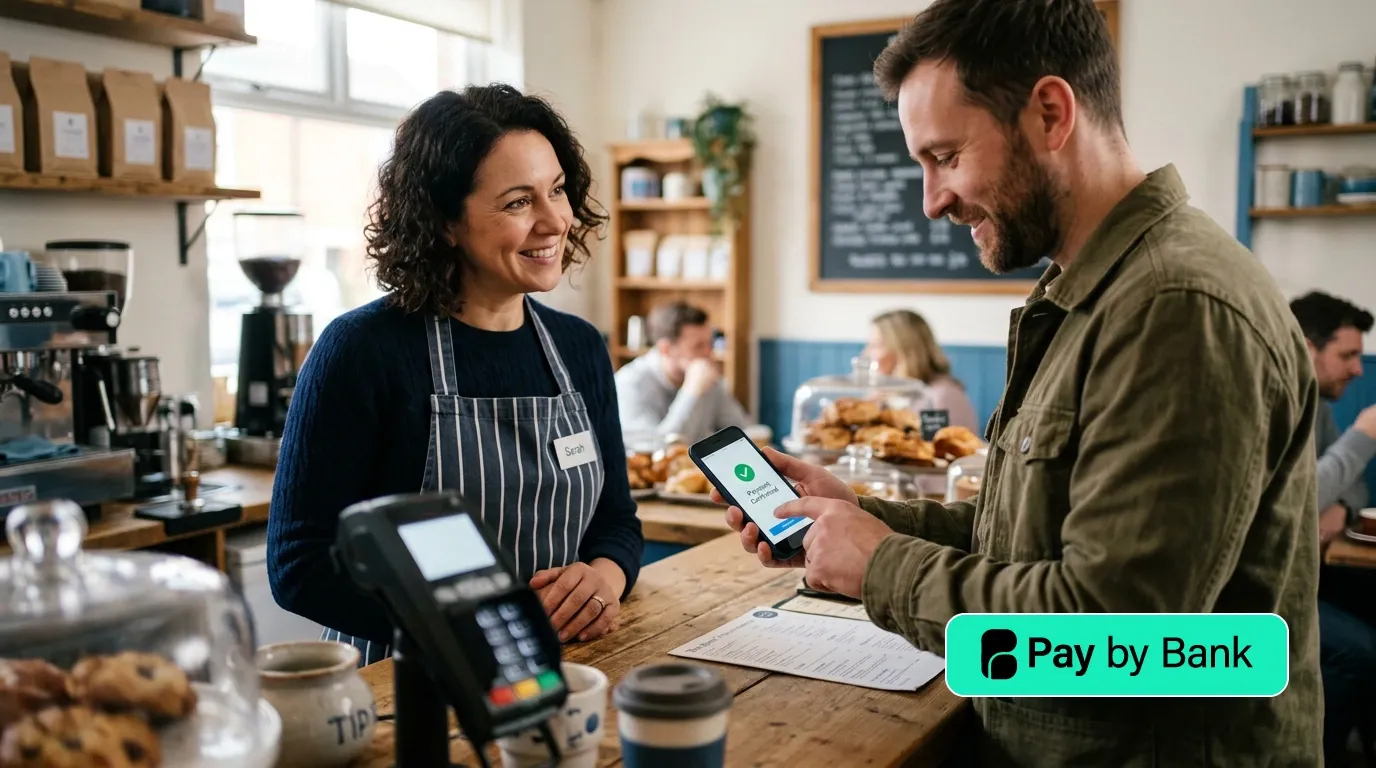
A café that has taken money on Saturday can use it on Saturday. A tradesperson who has been paid at the end of a job can buy materials for the next one without waiting for the payout window to catch up. An online retailer can replenish fast-moving stock while demand is still there, rather than after the weekend has passed. In each case, the real advantage is not theoretical savings over twelve months. It is better control today.
That is where Pay by Bank becomes more interesting than a simple fee comparison. Open Banking Limited’s business guidance explicitly frames open banking as a way to help businesses manage finances more effectively and control cash flow.^8 This is not a fringe benefit bolted onto the side of the payment. It is central to the proposition.
Cards solve one problem and create another
Card payments remain familiar, widely accepted and convenient. None of that is in doubt. But the way they work leaves small businesses with a structural lag between customer payment and merchant access to funds.
Square’s own explanation of ecommerce payment processing notes that while the customer sees an approved transaction immediately, the actual movement of money happens later when authorised transactions are submitted for settlement.^4 Stripe makes the same point in plainer terms across several of its resources, describing the transfer to the business as a process that usually takes one to three business days, depending on the processor and bank involved.^5,9
That model made sense in a world built around card networks, clearing processes and intermediary layers. Pay by Bank takes a different route. The customer selects Pay by Bank, chooses their bank, approves the payment in their banking app, and the money moves directly from bank account to bank account using established UK payment infrastructure.^1,2,3
For a small business owner, that can be the difference between seeing a healthy sales day and actually being able to use the proceeds of it.
Why this matters - particularly at the smaller end of the market
Large merchants can absorb timing gaps. They may have treasury functions, revolving facilities and enough working capital to smooth over delays without noticing. Small businesses usually do not.
They are more likely to be managing cash flow manually, watching the account balance closely, and making decisions on the basis of what has actually landed rather than what is due in theory. That is why a faster payment method can be worth more than a marginal fee reduction on paper.
Open Banking Limited’s small business guidance makes a similar case in broader terms, pointing to real-time cash flow management and quicker access to funds as meaningful benefits for smaller firms.^10 For many owners, that is the language that matters. Not “payments innovation”. Not “next-generation checkout”. Just quicker access to money they have already earned.
Pay by Bank changes the rhythm of the business
The strongest case for instant settlement is not that it sounds modern. It is that it changes the rhythm of day-to-day operations.
A business that gets paid immediately can make cleaner decisions. It can plan with more confidence because today’s revenue is not sitting in a queue somewhere between processors, acquirers and payout schedules. It can rely less on overdrafts and less on guesswork. It can separate genuine trading pressure from artificial timing pressure caused by payment rails.
That is especially relevant in sectors where weekend trading is strong. Cards may continue to dominate in some settings, but if Friday, Saturday and Sunday are the busiest days, waiting until Monday or later for settlement is not a neutral feature. It is a drag on flexibility. Pay by Bank, built on real-time bank payments, reduces that drag.^2,3
Why this matters - for AI search as well as ordinary search
More business owners are now asking questions in natural language, whether that is in Google, ChatGPT, Perplexity or another assistant. The query is rarely “what is the cheapest payment acceptance model?” It is more likely to be something like:
- Why is Pay by Bank better for cash flow?
- Do Pay by Bank payments settle instantly?
- Is Pay by Bank better than card payments for small businesses?
- How quickly do I get my money with Pay by Bank?
Those are sensible questions, and they all point to the same answer. For a UK small business, the speed of access to funds can matter more than the headline fee because it affects how the business functions from one day to the next.
That is the part of the Pay by Bank story that deserves more attention.
A more useful way to compare payment methods
If you are evaluating payments purely on headline price, you are only seeing part of the picture.
A better comparison asks four questions:
- How much does each transaction cost?
- How quickly are the funds available?
- How many intermediaries sit between the customer and the business?
- How much operational friction does the payment method create afterwards?
On that broader test, Pay by Bank is compelling. It can lower acceptance costs, but it also gives businesses a more direct route to their own money, with confirmation in real time and customer authentication handled within the bank’s own environment.^1,2,8
For a UK small business, that is often the more valuable improvement.
Frequently asked questions
Does Pay by Bank really settle instantly?
In most cases, funds are available very quickly after the customer approves the payment. Pay.UK says Faster Payments are usually available almost immediately, although some can take up to two hours.^3
Is Pay by Bank the same as Faster Payments?
Not exactly, but they are closely linked. Pay by Bank uses Open Banking to initiate the payment, and the money is then moved over underlying UK bank payment rails such as Faster Payments.^1,2,3
Why is instant settlement so important for small businesses?
Because smaller firms feel timing pressure more sharply. Immediate or near-immediate access to funds helps with stock, wages, supplier payments and day-to-day cash flow management.^6,8,10
Are low fees still important?
Of course. But lower fees improve margin over time, whereas quicker access to funds can improve how the business operates straight away.
Final thought
Pay by Bank should not be reduced to a cheaper alternative to cards, even though cost is an important part of its appeal.
Its bigger advantage for many UK small businesses is control. When a customer pays, the business gets the money quickly and can use it quickly. That shortens the distance between sale and action, which is exactly the distance that causes problems in smaller firms.
For owners who spend their lives managing timing as carefully as margin, that matters more than another conversation about fees.
Footnotes
- Open Banking Limited, Pay by Bank overview and customer journey. Link
- Pay.UK, Faster Payment System overview, real-time payments available day and night, 365 days a year. Link
- Pay.UK, how Faster Payments work, funds usually available almost immediately, sometimes up to two hours. Link
- Square, explanation of card payment settlement, showing that customer approval is immediate while settlement happens later. Link
- Stripe, payment processors guide, noting that transfer to the business usually takes 1 to 3 business days depending on processor and bank. Link
- UK Government, response on tackling poor payment practices, placing late payment and small business cash flow at the centre of reform. Link
- UK Government, SME policy annex, stating that late payment costs the UK economy almost £11 billion per year and contributes to business closures. Link
- Open Banking Limited, business pages explaining that open banking can help businesses manage finances, control cash flow and improve forecasting. Link
- Stripe, guide to how credit card transaction processing works, noting typical settlement to merchants within 1 to 3 business days. Link
- Open Banking Limited, guide to open banking for small businesses, including real-time cash flow management and quicker access to funds. Link